








The insurance company says the accident was your fault. Or they claim it was 50/50. Or they agree their driver caused the crash, but are disputing how seriously you were hurt. In every one of these scenarios, one question sits at the center: who is legally responsible, and how do you prove it?
Proving liability in Philadelphia is not about what you know happened. It is a legal and evidentiary process with specific elements you must establish, specific types of evidence that carry weight, and specific Pennsylvania rules that determine whether shared fault reduces or eliminates your recovery.
Key Takeaways
|
What “Liability” Means in a Philadelphia Car Accident Case
Liability means legal responsibility for harm. To recover compensation after a car accident in Pennsylvania, you must prove that another party’s negligence caused your injuries and losses.
The standard of proof is preponderance of the evidence: your version of events must be more likely true than not. This is sometimes described as 51% certainty. It is a lower bar than the criminal “beyond a reasonable doubt” standard, but it still requires real evidence built into a coherent narrative.
The Four Elements of Negligence in Philadelphia Car Accident Cases
Every successful Pennsylvania car accident claim rests on four elements. A real-world example follows each to show how each element applies in practice.
- Duty: Every driver in Pennsylvania has a legal duty to operate their vehicle with reasonable care: follow traffic laws, pay attention to road conditions, maintain their vehicle, and avoid conduct that creates foreseeable risk of harm. This duty exists automatically. In virtually all car accident cases, you do not need to prove that a duty existed. Example: A driver traveling north on Broad Street in Philadelphia has a legal duty to stop at a red light.
- Breach: The other driver failed to meet that standard of reasonable care. Speeding, running a red light, texting while driving, drunk driving, following too closely, and failure to yield are all breaches of duty. This is where most car accident cases are won or lost. Example: The driver runs the red light at Broad and Pattison Avenue and enters the intersection. That is a breach of their duty.
- Causation: The breach directly caused your injuries. This is particularly important when the defense argues a pre-existing condition or claims your injuries resulted from something unrelated to the crash. Medical records, imaging, and expert testimony establish causation. Example: The driver’s breach, running the red light, directly caused their vehicle to strike yours, resulting in your cervical disc herniation. Without the breach, no injury.
- Damages: You suffered actual, compensable losses: medical expenses, lost wages, property damage, pain and suffering, or other recognized harm. Without provable damages, there is no case, regardless of how clear the fault was. Example: Your emergency room bills, the MRI showing the herniation, your physical therapy invoices, and your employer’s documentation of missed work are your damages.
Types of Evidence Used to Prove Fault in Philadelphia Car Accident Cases
Evidence quality determines settlement value and trial outcome. These are the categories that carry the most weight.
- Police Report: The Philadelphia Police crash report documents the officer’s observations of fault, road conditions, any citations issued, and witness accounts. A citation against the other driver for speeding, running a red light, failure to yield, or driving under the influence (DUI) is particularly significant. Pennsylvania’s negligence per se doctrine holds that when a driver violates a safety statute, and that violation causes injury, breach of duty is established as a matter of law.
- Surveillance and Traffic Camera Footage: Philadelphia has traffic cameras at major intersections and speed safety cameras on Roosevelt Boulevard. Businesses along crash corridors – gas stations, pharmacies, ATMs, restaurants – frequently have exterior cameras that capture the crash or the moments leading to it. This footage is typically overwritten in 30 to 60 days. Preservation letters must go out immediately upon attorney engagement.
- Event Data Recorder (Black Box): Most vehicles manufactured after 2012 contain an Event Data Recorder (EDR) that captures speed, braking input, steering angle, throttle position, and seat belt status in the seconds before impact. This data has overturned disputes where the at-fault driver claimed they were traveling the speed limit. EDR data can be overwritten after subsequent ignition cycles. Preserving the vehicle before repairs is critical.
- Cell Phone Records: When distracted driving is suspected, subpoenaed phone records can confirm that the other driver was texting or on a call at the moment of impact. This is direct evidence of breach and often supports a claim for punitive damages.
- Witness Statements: Independent witnesses have no stake in the outcome and carry significant credibility. Their accounts can confirm the sequence of events and counter the other driver’s version. Collect witness contact information at the scene; their memories degrade meaningfully within months, and witnesses become harder to locate over time.
- Accident Reconstruction Experts: In serious injury cases, accident reconstructionists use physical evidence, vehicle damage analysis, road measurements, and physics to establish speed, angle of impact, and event sequence. For high-value or complex cases, the Law Offices of Greg Prosmushkin uses focus groups and mock trials to pressure-test how expert testimony will be received by a jury. This methodology is uncommon among regional personal injury firms.
- Medical Records: Emergency department records stating “patient presents following motor vehicle accident”create the causal link between the crash and your injuries. This link weakens every week that treatment is delayed.
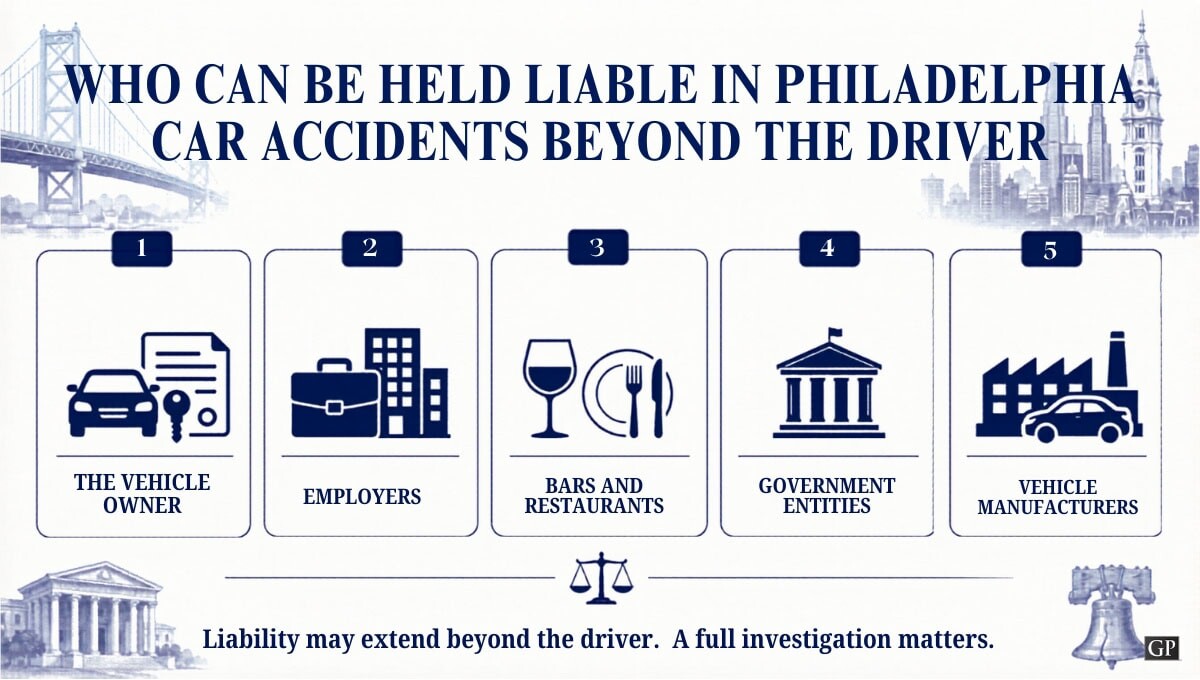
Who Can Be Held Liable in Philadelphia Car Accidents Beyond the Driver
Identifying every potentially liable party is one of the most consequential actions an attorney takes at the outset of a case.
- The vehicle owner. If the at-fault driver was using someone else’s vehicle, the owner may be liable under negligent entrustment, particularly if they knew the driver was unlicensed, impaired, or had a dangerous driving history.
- Employers. If the driver was operating a vehicle for work deliveries, commercial routes, or business errands, the employer is liable under respondeat superior. Amazon delivery drivers, rideshare drivers, commercial truckers, and Southeastern Pennsylvania Transportation Authority (SEPTA) operators all fall under this framework. Truck accident cases regularly involve multiple corporate defendants with separate insurance policies.
- Bars and restaurants. Pennsylvania’s dram shop law (47 P.S. § 4-497) holds licensed establishments liable when they serve alcohol to a visibly intoxicated person who then causes a crash. This creates a second defendant with an independent insurance policy in drunk driver accident cases. Our dram shop lawyers pursue these claims alongside the primary accident case.
- Government entities. PennDOT or the City of Philadelphia may be liable when road defects – potholes, missing signage, broken traffic signals, dangerous intersection design – contributed to the crash. Government vehicle and property accident claims require a written Notice of Claim within six months and have specific procedural requirements. SEPTA bus crashes follow the same government entity framework. Read more: SEPTA Mass Transit Accidents.
- Vehicle manufacturers. Defective tires, faulty airbags, brake failures, and electronic stability control malfunctions can shift liability to the manufacturer. Our defective product lawyers pursue product liability claims alongside the injury case.
Pennsylvania Comparative Negligence and How Insurers Use It Strategically
Pennsylvania follows modified comparative negligence under 42 Pa.C.S. § 7102:
- You can recover if you are less than 51% at fault.
- Your recovery is reduced proportionally by your assigned fault percentage.
- At 51% or more fault, you recover nothing.
Example: If your damages are $200,000 and you were found 25% at fault, you recover $150,000.
How insurers use this rule: The difference between 50% and 51% assigned fault is the difference between a significant recovery and zero. Insurance adjusters know this rule precisely. Telling you that you were “equally responsible” or “50/50” is a calculated negotiating position designed to pressure you toward a low settlement or to abandon the claim entirely. These percentages are disputed, not decided, and an experienced Philadelphia car accident lawyer builds evidence specifically to minimize your assigned fault and maximize the fault attributed to every contributing party.
Your Statute of Limitations for Philadelphia Car Accident Liability Claims
You have two years from the date of the crash to file a personal injury lawsuit in Pennsylvania under 42 Pa.C.S. § 5524. Missing this deadline results in dismissal regardless of how strong your liability evidence is.
Important exceptions:
- Claims against SEPTA or other government entities require a written Notice of Claim within six months of the crash.
- Minors have two years from their 18th birthday to file.
- Wrongful death claims run two years from the date of death.
Evidence like surveillance footage, black box data, and witness memories disappear long before the legal deadline. Call an attorney immediately after a crash, not when the deadline approaches.
Read our full guide: Statute of Limitations for Car Accident Claims in Philadelphia.
When the Insurer Disputes Liability: Our Results in Philadelphia Cases
When an insurance company disputes liability or undervalues a claim, their denial is a litigation position, not a legal finding. It can be challenged with evidence.
At the Law Offices of Greg Prosmushkin, disputed liability cases are a significant portion of our practice. Documented results where we reversed insurer positions:
- $247,500 recovered for a client whose case the insurer initially valued at $12,000 (approximately 20 times the opening offer)
- $500,000 recovered for a client whose prior attorney estimated the case was worth less than $100,000 (five times the prior valuation)
Greg Prosmushkin is a Keenan Trial Institute Master Graduate whose trial preparation includes focus groups to stress-test disputed liability arguments before they reach a jury – a methodology that directly shapes settlement negotiations.
We also review cases that prior attorneys dropped or undervalued. A second opinion from our firm costs you nothing. See our full case results.
Unsure whether to settle or go to court? That decision turns on the strength of the liability evidence and the defendant’s available insurance. We make this calculation with every client.
Philadelphia Crash Data: What the Numbers Reveal About Common Fault Patterns
According to PennDOT’s 2023 Crash Facts and Statistics, Pennsylvania recorded 110,382 total traffic crashes that year, resulting in 1,209 deaths and 66,563 injuries. Speed was the leading cause of all crashes (23,070) and fatal crashes (366). Distracted driving contributed to 9,011 crashes. Alcohol-impaired driving caused 265 fatalities statewide.
In Philadelphia specifically, the High Injury Network, just 12% of the city’s streets, accounts for 80% of all traffic deaths and serious injuries, per the City of Philadelphia’s Vision Zero Annual Report 2024. The most common fault factors on these corridors are excessive speed, red-light violations, and failure to yield to pedestrians.
These patterns matter because speed, distraction, and alcohol are almost always documentable through EDR data, traffic cameras, and cell phone records. Most disputed liability cases in Philadelphia have a path to proof – if an attorney acts before the evidence disappears.
Frequently Asked Questions
How Do I Prove Fault If There Were No Witnesses to My Philadelphia Car Accident?
Physical evidence tells the story without eyewitnesses. Vehicle damage location and severity, skid mark patterns, road geometry, and EDR (black box) data can establish what happened. Accident reconstruction experts are particularly valuable when witness testimony is absent or conflicting.
What If The Police Report Says I Was at Fault?
Police reports are not binding legal determinations of fault. They can be challenged with additional evidence. Officers record what they observe at the scene with limited information – a full investigation frequently produces a materially different picture. We review police reports in every case we take.
Does a Traffic Ticket Prove Fault in a Pennsylvania Car Accident?
A citation to the other driver creates strong evidence of liability under the negligence per se doctrine, which establishes breach as a matter of law. It is not automatically conclusive if the cited driver contests it, but practically speaking, a DUI or red-light citation dramatically shifts negotiating leverage in the injured party’s favor.
What If The Other Driver Fled The Scene?
File a police report immediately and preserve all scene evidence. Pennsylvania’s hit-and-run rules allow you to pursue your own uninsured motorist coverage even when the at-fault driver cannot be identified. A police report filed promptly is generally required to trigger this coverage.
How Long Does It Take to Resolve a Disputed Liability Car Accident Case in Philadelphia?
Disputed cases take longer than clear-liability cases. In our experience, disputed cases that settle short of trial generally resolve in 12 to 24 months from the date of attorney engagement. The strongest leverage points are typically black box data, surveillance footage, and the credible threat of trial by an attorney with a documented trial record.
The Insurer Is Wrong. Let Us Prove It.
The Law Offices of Greg Prosmushkin, P.C., has been winning disputed liability cases in Philadelphia for over 30 years. We advance all investigation and litigation costs. You pay nothing unless we recover for you.
Our team speaks English, Spanish, Russian, Polish, Ukrainian, and Italian. Our Northeast Philadelphia office at 9637 Bustleton Avenue is available 24 hours a day, 7 days a week.
Call 215-799-9990 or request your free case review.
Prior results do not guarantee a similar outcome.
Reviewed by Greg Prosmushkin, Philadelphia Car Accident Attorney – May 2026

